
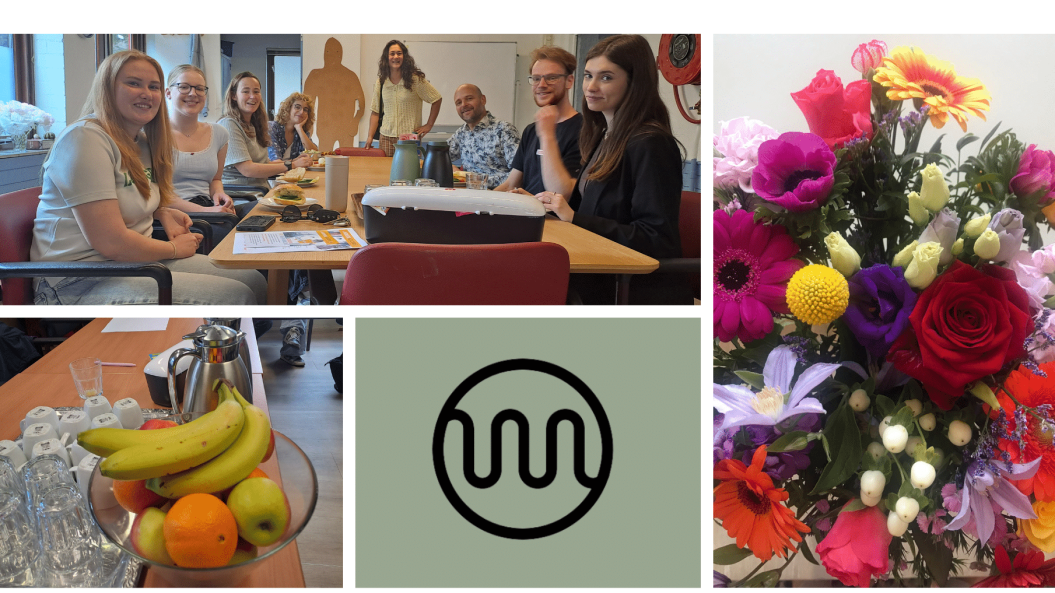
Our first full school year in Huis van de Wijk Carnisse is behind us! A year full of beautiful projects, fruitful collaborations, and new insights. In the upcoming school year, the Urban Leisure & Tourism Lab will be present again every Wednesday at the Texelsestraat, at Incluzio’s Bahia Mhimdan. We’re already looking forward to it!
Step by step, we’re moving toward becoming an interdisciplinary lab. In 2020, the Urban Leisure & Tourism Lab Rotterdam started with a minor in which students from different programs worked together in teams on a shared question. The questions in this minor were focused on tourism and leisure, but increasingly also touched on greening, movement, community feeling, and safety. The minor made way for projects by various final track students — first from within their own field, but increasingly in collaboration with students from other disciplines. This semester, students from different programs worked together around e.g the theme of safety, blended with creativity and public space. Each student had their own assignment but could also share their knowledge with the others — the interdisciplinary approach we’re aiming for.
An interdisciplinary perspective: a small selection from the many wonderful studies
Last year, for example, we reported on the festive opening of the hopscotch path at Carnissepoort, a project by final track student Karin Herweijer. We received signals that during the day, the area was experienced as pleasant, but in the evening was avoided, particularly by women. Students Isis Bandsma and Lieke van der Krol together researched how to improve the sense of safety in the area. Isis from the perspective of Integrated Safety Studies, Lieke from Tourism Management. In collaboration with the Municipality of Rotterdam, Lieke developed a concept for the social use of the ground floor (only to be realized once the new housing is completed), and Isis designed the layout of the outdoor space. Karlina van Boxtel, a Creative Business student, researched perceptions of safety in the metro in collaboration with the RET. Isis, Lieke, and Karlina regularly exchanged insights and introduced each other to the methods and techniques of their respective fields. Matteo van Kooten, from his Real Estate & Facility Management studies, also looked at the outdoor space of Rijnhaven from a very different angle than we’re used to from a tourism perspective. He also stepped outside his own comfort zone: he organized an inspiration walk around the Rijnhaven with performer Lester David.
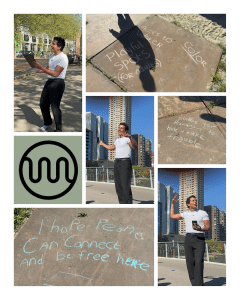
Meanwhile, Tyeisha Felipa investigated how meaning is formed around our earlier project, Mi Lobi Zuid. Her research showed that the interpretation of murals differs for everyone, and that the place and moment at which the art is seen strongly influence the meaning it takes on. Does a mural like this still connect people, even after the collective painting has taken place? Not necessarily — but the mural does symbolize an area in transition and inspires new dreams about possible uses for the space.
A semester in overview
The second semester offered a nice mix of engaging questions, solid collaborations, and interesting results. In total, around 15 students studied at the lab, in varying formations, of whom 12 have since graduated. And although it wasn’t always possible to get fifteen students together at the same time, we usually had enough people for a nice, shared lunch. Alongside our ‘usual’ (but unusually delicious) lunches, we also experimented this year with round-table lunches — in which a few guests of the lab discussed a current topic together. Milena Ivkovic presented her Urban Soul project and spoke with Fouad Akka of Casa Connect, and researchers Jimena Diamint and Adrienne Deelder. Together we explored the connection between greening and connecting. A few weeks later we had lunch with Luca Bailarini of Stratosferica / Utopian Hours. With him and a few colleagues, we talked about placemaking and social change. We also had guest lectures from Jan Rath, Guido Stompff, Richard de Vries, Krista Schram, and Marjan de Croon. On studio days, various partners dropped by to talk.
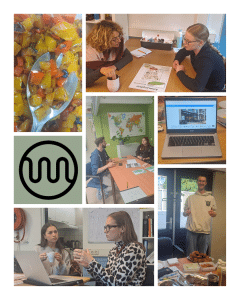
This year-end update can’t do justice to all the students’ wonderful projects. That’s why, in the new school year, we hope to publish a number of blogs talking more about the research from this past year. There you’ll also read about the adventures of the students that have not yet been mentioned here— like Lotte van den Bergen, who as a Landscape & Environment Management student, in collaboration with Auris, created a redesign for the Ammanplein; Sil den Hartigh, who experimented with new dishes made from food waste streams; Linda van den Akker, who connected young people with the Herstelacademie; Denise Bos, who developed “Rondje hart van Zuid” — ‘a home through the eyes of its residents’; Louiza Dahou, who developed a concept for V for Food — too many to name!
Meanwhile, in the second and third year
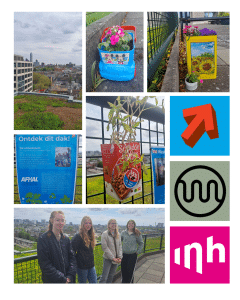
In the first semester, second-year students from the Animals in a Sustainable Society program tested the concept of the Ganzenpad (Goose Path). This had been developed earlier by third-year students: an interactive walk through Zuiderpark that lets participants discover how people and animals share the city. They developed a workshop on “liminal animals” — animals like geese, gulls, rats, and hedgehogs that aren’t tamed, but also can no longer live without the city. At De Klaver primary school, group 6 pupils enthusiastically got to work drawing, moving, and taking part in a quiz. In the second semester, second-year students from the same program once again took to the roof for the second year running during Rotterdam Roof Days. They showed how “upcycling” can go hand in hand with promoting biodiversity. What we now call “waste” can be used as a planter — for example, to make your balcony more lively: more small green oases means more living space for small animals and insects.
Interested in helping realize the Ganzenpad? We have room for a final track student on this topic.
Research and collaboration behind the scenes
This was our first year as an emphatically interdisciplinary lab; our second year starts in September. Collaboration with a wide range of research groups is well underway. A promising outlook: students and researchers from very different fields building the same city together. Our lab is also part of a larger whole: we’re affiliated with Expertise Network Sustainable Urban Tourism (Ensut) and together with our sister lab in Amsterdam-Noord, we’re a member of the European Network for Living Labs. The lab in Amsterdam is also innovating a lot — they recently moved to a new, permanent location and now have a digital twin.
Plenty happened outside of teaching at the lab too. Donagh Horgan and Maaike de Jong wrote a paper on the role Living Labs can have in challenges regarding urban sustainability. In this way, we also reflect on our activities at a research level. Researcher Veroniek Maat published the book ‘All Aboard’, which also featured the work of our graduate Kathleen Yorkon accessible travel. We’re seeing more exchanges emerge: students bringing insights from the lab back into their own program and bringing new insights from their program into the lab.
We’re continuously looking for ways to build on the work of the researchers in our network and the contributions of earlier graduates. We build on ideas that already have a foundation. We also do this by devising forms of research that don’t feel like research, but like a fun and meaningful activity. Earlier, we started with a mural, social sports activities, and shoebox design sessions. This semester we experimented with, among other things, an inspiration walk and a coloring page for children. Next year we hope to also work more often with theatre.
See you after the summer!
We’re taking all the lessons from this semester with us into the new school year, and we’ll keep you posted. Whether you collaborate with us, represent us as an ambassador, graduate with us, or read and share our stories — thank you for wanting to be part of our development and our adventures.
Do you have a question you’d like to research with us, or are you considering graduating at the lab? We’d love to hear from you.
Get in touch with Maaike — she’s available again as of August 17th.